

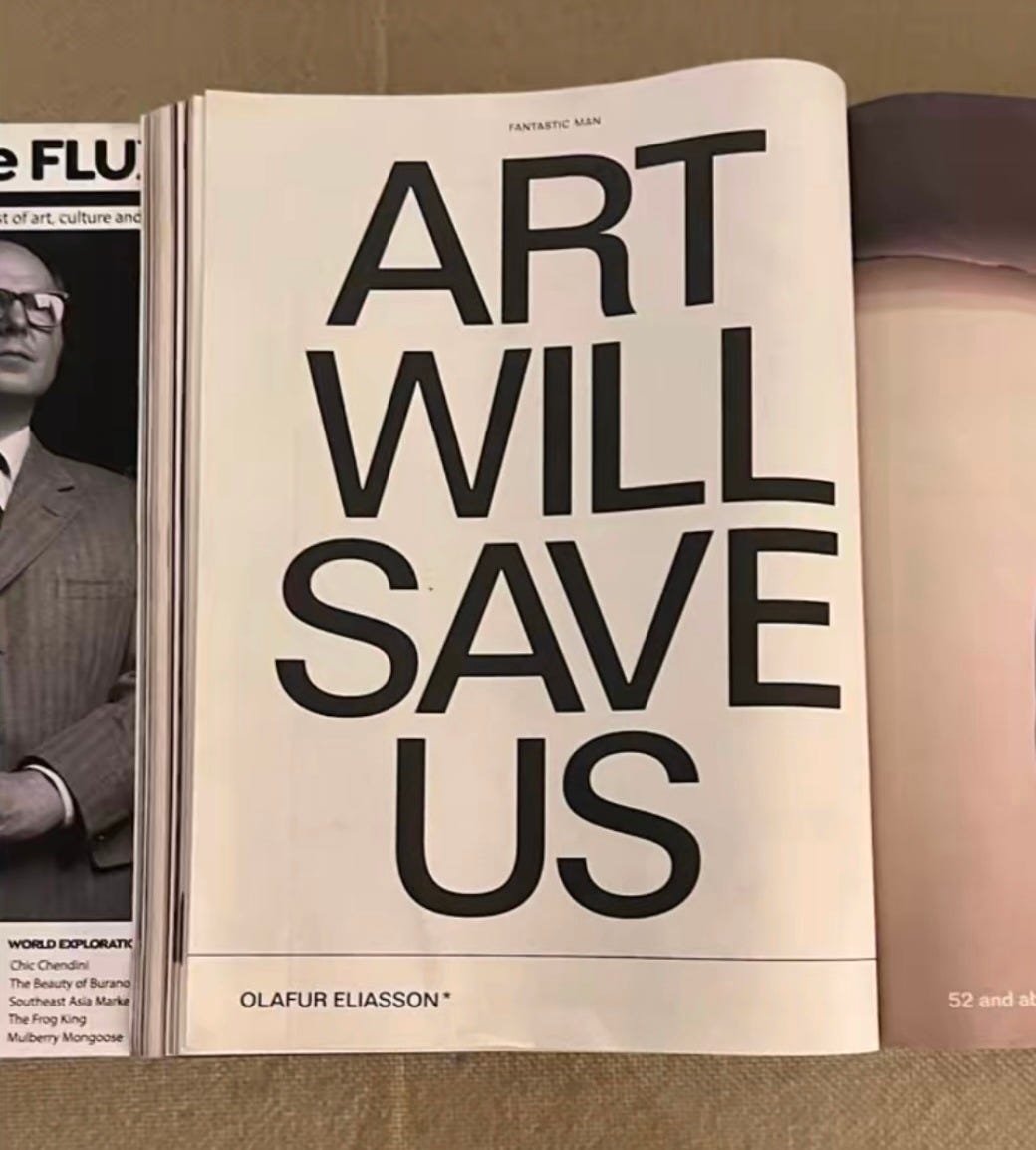
Kant: the beautiful vs the sublime
In his Critique of Judgement (1790), Immanuel Kant draws a distinction between the beautiful and the sublime.
The beautiful concerns form. It is bounded, harmonious, restful. It reconciles us with the world.
The sublime, by contrast, begins where form breaks down: the storm at sea, the mountain range, the starry sky, the mathematically infinite.
These do not please us; they overwhelm us. Our senses cannot fully take in what stands before us. For a brief moment, we experience our own smallness.
Yet paradoxically, this experience elevates us.
Why? Because although nature exceeds our senses, we discover something in ourselves that exceeds nature: reason, the capacity to think the infinite even when we cannot picture it.
The sublime humiliates the senses and exalts the mind.
Schopenhauer: art as an escape from suffering
Arthur Schopenhauer begins from a much darker premise.
In The World as Will and Representation (1818), reality itself is the problem. Beneath every appearance lies the Will: a blind, aimless, insatiable striving that manifests in everything from gravity to hunger to love. To exist is to want, and to want is to suffer. Satisfaction is momentary; the pendulum swings between pain and boredom.
If suffering originates in desire, can we ever become free?
Schopenhauer proposes three paths.
One is ethics, through compassion. By recognising ourselves in others, we loosen the grip of selfish desire.
Another is asceticism, the radical denial of worldly wants. Saints and monks embody this path, attempting to extinguish desire altogether.
Then there is a third path, perhaps the most accessible of all. Art.
In aesthetic contemplation, the subject stops willing. We cease to be an individual with appetites and become, in his phrase, the pure, will-less subject of knowing.
For Schopenhauer, specifically music stands above all the other arts, because it is a direct copy of the Will itself.
Nietzsche: between Apollo and Dionysus
For Friedrich Nietzsche, writing in The Birth of Tragedy (1872), Greek tragedy revealed the deepest truth about existence because it united two opposing forces:
The Apollonian – order, reason, proportion, clarity.
The Dionysian – instinct, ecstasy, chaos, transformation.
Neither alone suffices. Pure Apollo is an illusion of harmony; pure Dionysus is annihilation. For Nietzsche, this tension is life itself.
This idea feels surprisingly contemporary.
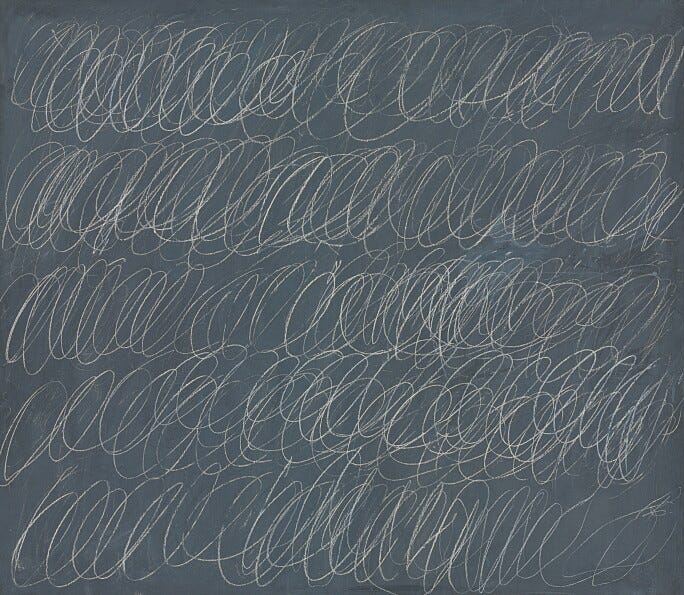
Take Cy Twombly: loops that whirl with genuinely Dionysian violence, gesture on the edge of formlessness, and yet held, barely, by an Apollonian intelligence of composition.
So... will art save us?
Through beauty and the sublime, we measure ourselves against the infinite and discover a mind that exceeds its own senses. Through contemplation, we suspend the machinery of wanting and glimpse what it feels like to simply know. Through the tragic, we look directly at chaos and give it a form we can bear.
Art, in other words, is how human nature exercises itself: how it transcends, how it rests, how it affirms. Art and beauty keeps us human, and being fully human may be the only salvation on offer.
Thanks for reading ! Subscribe to my newsletter for more and follow along on Instagram 💋