


The Reader in the Room
Somewhere in the jungles of Ubud, there is a tent that belongs to a cartographer. Not a real one. There is no cartographer. There never was. But the maps are hand-drawn, the instruments are worn at the edges, and the objects arranged across every surface tell a story so precisely that you find yourself believing it anyway. You unpack your bag in someone else’s fiction. And somehow, it feels more real than most places you have actually been.
French philosopher Jean Baudrillard spent much of his career trying to account for exactly this feeling. In Simulacra and Simulation (1981), he described a world in which the symbol becomes more important or authoritative than the original, essentially where authenticity is replaced by copy, and reality gives way to what he called the “hyperreal”. The fiction, he argued, does not conceal the truth. It is the truth, or at least the only version of it that registers emotionally.
Whether by instinct or intention, Bill Bensley’s hotels operate on exactly this logic.
Bensley is the Bangkok-based designer behind some of Southeast Asia’s most obsessively realized hotels—essentially properties that move in the opposite direction of universally palatable designs, toward the specific, strange, overstuffed, and sincere. His hotels are stories themselves, told through objects. And what makes those stories hold is something French theorist Roland Barthes understood long before hospitality caught up: that meaning does not live with the author. It lives with the reader. In The Death of the Author (1967), Barthes argued that a text’s unity lies in the audience, not the creator.
In that tent in Ubud, the invented cartographer is not the point. You are the point. You are the reader completing the narrative by walking through it.
This is what Bill Bensley does, and there is no one quite like him.
Capella: The Brand With No Template
To understand why Bensley’s work lands the way it does, it helps to understand who he is building for.
Some of Bensley’s most notable works fall under Capella Hotels and Resorts. Capella is not a large brand. It does not want to be. With fewer than twenty properties worldwide, it sits at the quieter, more considered end of ultra-luxury hospitality, raising the bar in the Asian market on the conviction that a hotel should feel like nowhere else on earth.
Capella Hanoi: The Opera That Never Ended
Capella Hanoi opened in 2021 inside a colonial-era building in the city’s French quarter. The property is organized around a fictional world of performers, impresarios, and traveling artists who supposedly passed through the building during Hanoi’s early twentieth-century golden age of opera. More than a thousand pieces of memorabilia populate the interiors, including costumes behind glass, playbills pinned to walls, stage props arranged as if someone just set them down. Each piece is tied to a character: invented, named, given a backstory. The objects are real. The grief of a soprano who never existed is somehow, inexplicably, present in the room. The hotel is a kind of living archive of a world that never was—and that is precisely why it lingers.
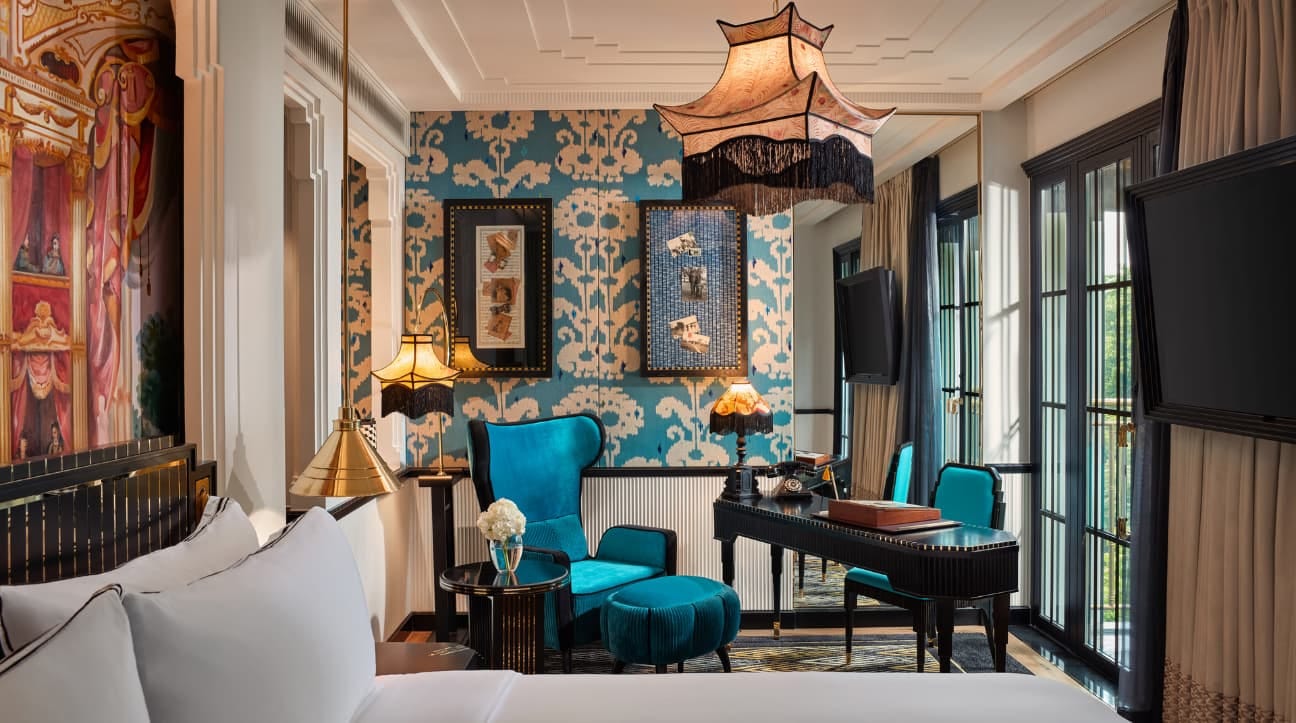
Capella Hanoi Junior Suite — Source: Capella Hotels
Capella Ubud: A Jungle of Invented Lives
If Hanoi is a stage, Ubud is an expedition.
Capella Ubud is a collection of tents and pavilions suspended in the Balinese rainforest. Each tent is built around a distinct persona—the explorer, the cartographer, the naturalist, the storyteller—with handcrafted objects, commissioned artifacts, and locally made furnishings chosen to make that identity feel genuinely inhabited. Guests arrive at a life in mid-sentence: maps half-unrolled, specimens pinned to boards, journals left open on a desk.

Capella Ubud Terrace Tent — Source: Bensley
Competitive Advantage, By Object
Bensley has been explicit that his design philosophy is not meant to please everyone: “if you try to satisfy everyone, you will only create a basic box.”
It’s a strategic position that maps onto what management theorists have spent decades trying to articulate. In his foundational 1991 paper in the Journal of Management, Jay Barney argued that sustained competitive advantage derives from resources that are valuable, rare, imperfectly imitable, and non-substitutable. The VRIN framework, as it became known, is usually applied to corporate capabilities and supply chains, but it describes a Bensley property quite well. A sourced antique is valuable. A commissioned narrative built over years is rare. A thousand pieces of opera memorabilia tied to invented characters is imperfectly imitable. And no amount of capital can substitute for the accumulated curatorial decisions that produced it.
This is the commercial logic that most hotel procurement departments miss. They are optimizing for cost efficiency within a category, focusing on selecting furniture, art, and objects that hit a price point, when the actual competitive question is whether those objects can be replicated by a rival with the same budget. With this kind of thinking in mind, what emerges is a subtle though consequential shift, where the hotel becomes an opinionated environment—one whose opinion, expressed through objects, compounds into brand differentiation on the property and pricing power at the revenue management level.
An important distinction to make, however, is that not every hotel should attempt what Bensley does. Most cannot, and should not. At the ultra-luxury end of the market, where location is table stakes and service quality is assumed, the conventional levers of differentiation have largely been exhausted. What remains, and what commands the most durable pricing power, is irreproducibility. Bensley is evidence of where value can be generated when everything else has been commoditized.
The Financial Paradox
An opinionated environment, it turns out, has an accounting problem.
In standard hotel development, interiors are classified under FF&E—furniture, fixtures, and equipment—and depreciated on a fixed schedule, typically over seven to ten years. Every line item in the room is assumed to move in one direction: down.
Art breaks that assumption. And the deeper you look, the stranger it gets.
Under GAAP accounting, a curated collection sits on the books at original purchase cost, depreciating like any other FF&E asset—eventually written down to zero. In reality, well-assembled collections can hold or appreciate in value over decades, quietly moving in the opposite direction to everything else on the balance sheet. This gap between book value and fair market value—invisible on the income statement—is a real source of wealth that standard hotel accounting often cannot see.
The practical implications for owners and developers are clear. Not everything in a Bensley property appreciates—custom upholstery, soft furnishings, and lighting fixtures follow the standard FF&E depreciation curve like any other hotel interior. But within the same room, a sourced antique, a site-specific work, or a locally made artifact with genuine provenance follows an entirely different curve. The balance sheet treats them identically. Standard accounting cannot distinguish between a sofa and a piece of opera memorabilia tied to an invented character in a fictional narrative—both are written down on the same schedule, toward the same zero.
The gap between those two curves is where the mispricing lives. Art-forward properties are likely being underwritten on compressed NOI assumptions that fail to account for the pricing power a curated environment generates. RevPAR premiums driven by narrative identity and irreproducibility do not show up as a discrete line in the pro forma—they are absorbed into blended rate assumptions and treated as a function of location or brand rather than curatorial investment. The result is that at acquisition, the cap rate calculation systematically undervalues exactly the assets that drive the most durable outperformance.
The Designer Who Builds for You
Most hotels are built to be understood immediately. Bensley’s are built to be completed by you, walking through them, choosing what to believe. In turn, his properties command higher rates, resist imitation, and accumulate value in ways the balance sheet cannot see.
The reason Bensley remains genuinely difficult to replicate is not the antiques, or the memorabilia, or the hand-drawn maps. It is the understanding that a hotel is a text, where the guest—unpacking their bag in someone else’s fiction, half-believing in a cartographer who never existed—is always the reader.
Nobody else in hospitality is building for that reader. Bensley has been doing it for thirty years.
Thanks for reading this article in collaboration with Viraj Bajoria ! Subscribe to my newsletter for more and follow along on Instagram 💋