

There is something slightly exhausting about the idea that every part of our lives could be better.
We can sleep better, eat better, work better, exercise more efficiently, invest more intelligently, and travel more strategically. We can do all of this so thoroughly that there is almost no possibility of accidentally ending up somewhere we did not intend to be.
Even leisure has become strangely productive. A holiday can be researched for weeks, a morning walk can contribute to a step count, a dinner reservation needs to be worthy of the evening, and an exhibition somehow feels more valuable when it comes recommended by someone whose taste we trust.
None of these things are inherently bad. I love a beautiful hotel, a good recommendation and the satisfaction of discovering somewhere worth remembering. I would also rather sleep well than badly, and I have no desire to romanticise inefficiency for its own sake.
Still, I sometimes wonder whether our obsession with improving life has quietly changed the way we experience it.
What happens when we become so busy designing a good life that we forget to actually live it?
At some point, living well became something of a project.
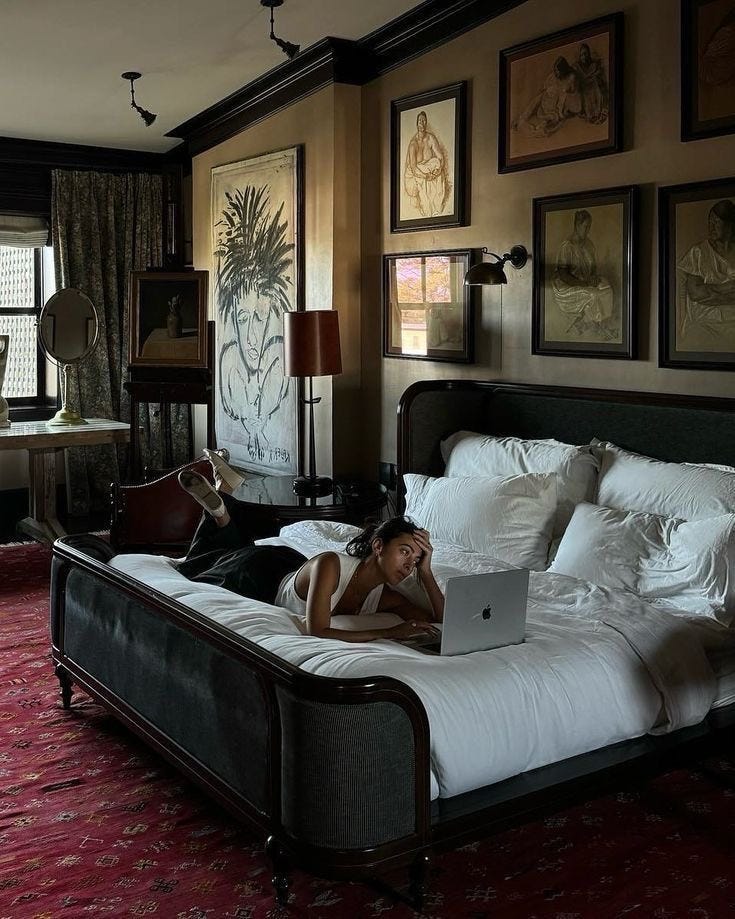
When everything can be improved
Optimization makes perfect sense when applied to machines. If a process can be made faster, cheaper or more efficient without sacrificing quality, there is little reason not to improve it.
The logic becomes more complicated when we apply it to ourselves.
Technology has given us an extraordinary ability to measure and compare parts of life that were once largely intuitive. We can know how deeply we slept, how many calories we burned, whether our heart rate was optimal and how productive we were over the course of a day. We can compare hotels before ever entering them, restaurants before tasting their food and destinations before seeing them with our own eyes. Even our romantic lives increasingly lend themselves to this logic. Dating apps allow us to sort through people according to countless preferences, which is undeniably appealing when the alternative is leaving everything to chance.
The promise of optimization is appealing because uncertainty is uncomfortable. If enough information is available, perhaps we can avoid the disappointing restaurant, the mediocre hotel, the wasted afternoon, the wrong date or the wrong decision.
And increasingly, there is always someone willing to tell us the right one.
We have become very good at avoiding bad choices. I’m less certain that this has made us better at discovering unexpected ones.
The cult of the curated life
Optimization has also extended beyond performance into appearance. We don’t simply want the best life; increasingly, we want the most coherent one.
Our homes, wardrobes, holidays, books and even hobbies can belong to the same carefully constructed universe, as they can all be expressions of who we are. We save references, follow people whose lives resemble the ones we imagine for ourselves and gradually develop an increasingly precise picture of what our idea of a good life is supposed to look like.
The problem begins when curation becomes a form of control.
When everything is encountered first through somebody else’s photographs, we arrive with expectations before we have experiences.
Instead of asking ourselves what we think of a place, we can find ourselves looking for the version of it we were promised.
The same thing happens beyond travel. We increasingly encounter objects, books, art, fashion and even people surrounded by context telling us how desirable they are. By the time something reaches us, it has often already been reviewed, ranked, photographed and approved.
Perhaps this is why so many beautiful things can begin to feel strangely familiar. We have seen them before we have seen them.

A life that looks right
There is another consequence of living so deliberately: life can slowly become something we observe from the outside.
We start asking whether things fit. Does this chair belong in my home? Does this purchase fit my wardrobe? Is this the kind of place I would normally go? Is this person someone I can imagine fitting into the life I have planned for myself?
These can sound like trivial questions, but I think they reveal something larger.
Once we develop a strong idea of who we are, it becomes tempting to protect that idea by choosing only the things, experiences and people that reinforce it.
Personal taste can easily become personal branding, and perhaps the same can happen to our idea of happiness. We don’t only want to be happy; we want happiness to arrive in a form we recognise.
Yet the irony is that many of the things that eventually become most meaningful to us would probably never have survived such careful selection.
These things acquire meaning precisely because they were allowed to surprise us.
The case for inefficiency
Some of the best things we do are remarkably inefficient.
Wandering around a city without Google Maps is objectively a terrible way to get from one place to another. Spending an afternoon looking at paintings will probably not make you more productive, and staying at dinner for another three hours is unlikely to improve tomorrow morning’s sleep score. Falling in love has never been particularly aligned with schedules, plans, checklists or five-year goals.
Art itself is almost defiantly inefficient. We spend hours making, studying and preserving objects that often have no practical function whatsoever, yet we continue to consider them among the most valuable things civilisation has produced.
Perhaps that tells us something.
Efficiency is useful when we know exactly where we want to go. It is less useful when the point is discovering where we might want to go in the first place.
There are parts of life where taking the shortest route makes perfect sense, and there are others where the detour is the entire point.

Leaving room for accident
I don’t think the answer is to stop planning in the name of spontaneity, because I believe having a clear intention is a cornerstone of any achievement. There is no particular virtue in making life harder than it needs to be, just as there is nothing inherently shallow about wanting a beautiful home, a thoughtful wardrobe or a life that feels considered.
The more interesting question, at least to me, is how much room we leave for accident.
An afternoon on a trip without a reservation. A book chosen because you stumbled across it rather than because someone recommended it. Something bought simply because you love it, despite the fact that it doesn’t quite fit your aesthetic. Maybe even an opinion formed before checking what everyone else thinks.
There is a kind of freedom in allowing some experiences to remain inefficient because they do not need to lead anywhere or improve anything. They can simply occupy time.
This might be increasingly difficult in a culture that encourages us to treat time as a resource that should always be used well. Yet some of the hours we remember most fondly are probably the ones we would have struggled to justify in advance.
Perhaps a good life needs some bad planning
I just wonder whether a perfectly curated life leaves enough room for us to change.
If every choice confirms who we already believe ourselves to be, there is very little opportunity to discover that we might like something else or become someone slightly different from the person we had planned.
Perhaps living well requires a strange balance between discernment and surrender: knowing enough to recognise what is good, while remaining curious enough to be wrong about what we thought we wanted.
We spend so much time trying to make life better that it is easy to forget how much of what makes it interesting was never planned in the first place.
Perhaps the parts of life we fail to optimize are the ones that eventually make it ours.
Thanks for reading ! Subscribe to my newsletter for more and follow along on Instagram 💋